Rare Books
The Chilian club : (a diversion)
Image not available
You might also be interested in
Image not available
Our maiden voyage
Manuscripts
This bound volume contains letters written by A.A. and Caroline W. Butler to their mother, while they were traveling through Europe for four months in 1891. The letters give a day-by-day account of the trip and detailed descriptions of the places they visited including, Boulogne-sur-Mer, Pontarlier and Paris, France; Brussels, Belgium; Cologne, Germany; Lucerne, Switzerland; and London, England. Pasted throughout the volume are images cut out from magazines and other printed sources, maps and photographs. These images are usually labeled by hand and are used to illustrate the Butlers' tour of Europe
mssHM 60315
Image not available
George W. McCune diaries
Manuscripts
Set of four diaries kept by George W. McCune while he was serving as a missionary in England from 1896-1898. The first volume begins with his departure from Nephi in January 1896 and traces his travels by train to Philadelphia and his subsequent sea voyage to Liverpool. McCune's missionary work centered around Norwich, but the diaries also record his travels to London, Wymondham, Lowestoft, Nottingham, Birmingham, Ipswich, Eastbourne, and Lyme. The fourth volume also recounts his December 1897 tour of Versailles, Paris, Brussels, Waterloo, Rotterdam, and The Hague. The fourth volume concludes with McCune's return voyage to New York in March 1898 and follows his return to Utah as far as Denver, where he arrived in April 1898.
mssHM 37546 (1-4)
Image not available
George Willing Clymer letter to Mary Willing Clymer
Manuscripts
Letter sent by George Clymer to his mother while he sailed on the Constellation for his first deployment as a US Navy apprentice surgeon. The Constellation set sail from New York on August 14, 1829, and arrived in the West Channel near Cowes, England, on September 11. Clymer begins by briefly recounting the "gloomy epistle of a landsman" that he had sent to his father regarding the difficult ocean crossing, and relating his excitement at finally spotting land off the Isle of Wight. Much of Clymer's detailed and eloquent letter is devoted to describing the scenery and towns he saw in England, along with historical anecdotes. After being allowed to go ashore he explored Cowes, which he noted was "different from the towns I had seen in America, and wears and air and aspect of a city." He was also struck by the "roast-beef and porter corporations, and the ruddy faces of the well-fed Englishmen," and widely praised the island's roads and means of transportation. He visited West Cowes Castle and the Royal Yacht Club and gives an extended description of attending afternoon tea at a hotel. After being denied permission to travel to London, Clymer returned to the Isle of Wight, seeing Carisbrooke Castle, Appuldurcombe Park and Mansion, Parkhurst Forest, the Albany Barracks, Newport, and Norris and East Cowes Castles. On a subsequent shore leave he briefly traveled to Portsmouth Harbor, Portsea, Portsmouth, and Southampton. On returning to his ship for the last time, he wrote that "I can now declare that I have passed [in England] fifty of the happiest hours of my life." He later cooled his opinion somewhat, lamenting the "extravagant beyond expectation" costs in England (which he recorded in some detail) compared to those in the United States, the "knaves" who charged higher prices to Americans, and the necessity of tipping servants. He concluded that he found the English "polite, but grossly ignorant of America." After being refused a gun salute by British naval officers, the Constellation circumnavigated the Isle of Wight and set sail south on September 21. Clymer compares the Spanish and African coasts, writes of being impressed by the town and fortress of Gibraltar, describes the Mediterranean Sea, and notes passing the islands of Formentera and Majorca. The Constellation approached Mahon Harbor in Minorca, where they were to meet the ship Delaware, on October 15, but a major storm blew the ship back out to sea. It finally reached the harbor on October 18, and Clymer concluded that "we had performed a voyage of 1500 miles in 28 days; the time we required in sailing twice that distance from New York to Cowes."
mssHM 79957
Image not available
George J. Abbott letter to Rev. Abiel Abbott
Manuscripts
George J. Abbott opens the letter with some brief news about a family visit to Cincinnati, Ohio. Abbott then discusses a visit from the Winnebago Indian delegation to Washington, D.C. He writes, "Washington has been enlivened by the visit of Winnebago Indians, whom, the Government wishes to remove for the third time from lands solemnly and inviolably guaranteed to them on the faith of Treaties" (p. 1). He continues with a description of negotiations lasting four days between three American negotiators and the chief orator of the Winnebago Indians named Little Hill. "They held out for very good terms, and obtained them, considering it was weakness dealing with power" (p. 1). Next, he describes the feelings of a respected chief. This chief tells the commissioners, "...their hearts were saddened by what he had told them of their decreasing number and of the near extinction of their race. When he spoke of the Great Father's disregard of his children & of the Great Spirit, a smile ran round the room - as every body thought it was a remark true as it was keen" (p. 2).
mssHM 80951
Image not available
Bedouin tribes of the Euphrates
Rare Books
Lady Anne Blunt (1837-1917), daughter of the Earl of Lovelace and granddaughter of Lord Byron, is known as an adventurous traveler to the Middle East and the most accomplished horsewoman and breeder of Arabian stock of her era. She was married to poet and diplomat Wilfrid Scawen Blunt (1840-1922). When he inherited a family estate in Sussex in 1872, the couple was able to establish a stud at their Crabbet Park home. They then traveled in the Middle East to purchase Arabian horses from Bedouin tribesmen, which they transported back to England. In 1878 Lady Anne journeyed from Beirut, across northern Syria, and south through Mesopotamia to Baghdad. From there she traveled north along the Tigris River and west across the desert to the Mediterranean port of Alexandretta (present-day Iskenderun, Turkey). In 1879 she again set out from Beirut, but traveled south through the Emirate of Jabal Shammar, reached its capital of Ha'il, across the Arabian Peninsula, and continued to the port of Bushehr (present-day Iran). Shown here is the first edition of Bedouin Tribes of the Euphrates. It is one of two books that Lady Anne wrote based on her travel diaries during these journeys (the other is A Pilgrimage to Nejd). Edited by Wilfrid Scawen Blunt, the book concludes with a few chapters that he wrote on "the Arabs and their horses." In 1882 the couple opened a second stud outside Cairo, which they called Shaykh 'Ubayd. The couple separated in 1906, and in 1913 Lady Anne left England and moved permanently to Shaykh 'Ubayd. She died in Cairo in 1917. She is credited with helping preserve the purebred Arabian horse and was known by her friends as the "noble lady of the horses."
635889
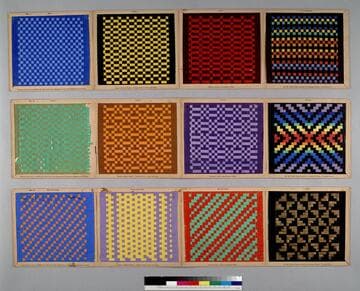
Books without Words. (Volume First)--Color and Form
Visual Materials
One set of paper weavings created by Emily M. Coe, ca. 1880. The set is comprised of five "books," plus three loose "pages" of paper weavings "manufactured only by Emily M. Coe, New York, originator of American Kindergarten System." They are marked "No. 1"-"No. 4"; only the 5th book is unnumbered. There are a total of 23 paper weavings, four per book plus the three loose pages. Each "book" has its title on the bottom of the third page, such as "Primary Colors--Curvilinear Solids," the first part of the title refers to the four paper weavings, the latter, the printed objects on the reverse of each page. For example, Book "No. 1,", "Primary Colors--Curvilinear Solids" has one page labeled "Blue" showing two tones of blue woven together, and on the reverse a shaded ball; the next is "Yellow" showing yellow and black interwoven, on the reverse a shaded oval; the third is "Red" showing red and a russet color mixed, with a shaded cylinder; and the last page is "Mixed Primaries" showing color changes as primaries mix, and on the reverse a shaded cone. The other "books" are labeled: No. 2, "Secondary Colors--Rectilinear Solids"; No. 3, "Complimentary Colors and Quadrangles"; No. 4, "Tertiary Colors--Polygons"; and the fifth, "Mixed Tertiaries--Triangles". The fourth paper weaving in each of the books is somewhat different than the others. In Books 3-5 there are black and gold weavings entitled "Fancy", with the weavings from 4 and 5 spelling out the words "FOR MA" and "FOR PAPA" respectively. Also of note: in the corners of the first drawing image are trademarks in the upper right and left corners, on the bottom corners are reproductions of a medal, one side of which reads "International Exhibition, Philadelphia MDCCCLXXVI". "Miss Ida Young[?]" is written, in ms., on top of the unnumbered fifth book.
ephKAEE